Showing posts with label guitar. Show all posts

Thursday, March 22, 2012

Worship Tutorials

Looking to figure out how to play a specific song?  Do you need chord charts?  Maybe an instructional video might be helpful.  Check this site out for great tutorials and downloadable charts; all for free.  That's right, I said FREE. 


Tuesday, February 22, 2011

StudyBass.com

Yes, for all you wonderful low-end boom providers.  Today I bring you a website I came across just last week.  A comprehensive step by step curriculum on how to play bass.  I love it.  Very detailed. 

Wednesday, June 30, 2010

Learn Your Neck

by Israel Doria

Like many of you, I learned to play the guitar on my own. This means that I simply learned chord shapes and scale shapes that were unrelated to each other. I learned fret numbers instead of note names and tablatures instead of music notation. These are all good things to know, but its also very important that we, as guitar players and musicians, take the time to learn theory and apply it to our playing. It is imperative that we learn the notes on the neck, key signatures, chord tones and put them all together to make music that works.

MUSICAL ALPHABET

The first thing we need to get under our belts before we start hammering away at memorizing these key signatures is the musical alphabet.

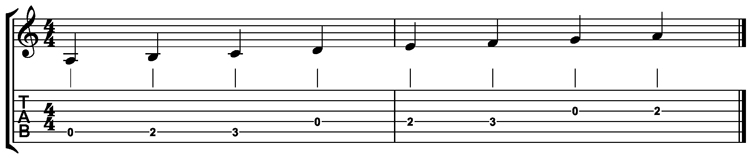
There are seven letters in the musical alphabet: A, B, C, D, E, F and G. Once you reach the end, it starts over and continues in each direction infinitely. Go ahead and play these notes on your guitar.


You'll notice that some notes are two frets apart where other notes are only fret apart. These are called whole steps and half steps.

Accidentals
In addition to these notes, we have what are called accidentals.We will go over three kinds of accidentals: sharps, flats and naturals.

A sharp sign(#) raises a note a half step.
A flat sign(b) lowers a note a half step.
A natural sign(♮) cancels out any other accidental.

Chromatic Scale
Now its time to put the two together. The chromatic scale is a scale that includes every note within an octave. In the key of  A, it would look like this:

A - A#/Bb - B - C -C#/Db - D - D#/Eb - E - F - F#/Gb - G - G#/Ab - A

This scale is the same in any key. Lets take a look at E:

E - F - F#/Gb - G -G#/Ab - A - A#/Bb - B - C - C#/Db - D - D#/Eb - E

Application to Fretboard
The chormatic scale and understanding of the musical alphabet and accidentals will help you learn and memorize the fretboard. In order to get a point of reference, we need to memorize the open strings. The 1st string is the thinnest one and the 6th string is the thickest. The names of the strings are:

1 - E
2 - B
3 - G
4 - D
5 - A
6 - E

Now you can figure out any note on your guitar's fretboard! For instance, if you want to know what the 7th fret on the top string is, you know the top string is E and if you could seven half-steps up from E you'll see that the 7th fret is B.  This may seem tedious and boring but it is imperative to your playing that you memorize the fretboard. Next time, we'll talk about key signatures and how to control the vast range of notes
that the guitar provides.


RESOURCES:

Musical Alphabet
(http://www.guitartutoronline.com/index.php/Beginners/The-Basics/musical-alphabet.html)

Sharps
(http://www.guitartutoronline.com/index.php/Beginners/Learning-The-Strings/sharps.html)

Flats
(http://www.guitartutoronline.com/index.php/Beginners/Learning-The-Strings/flats.html)

Tuesday, April 20, 2010

A Few Recommendations (Part 2 of 3)

Balance Your Group
Most guitar amplifiers are about 2 feet tall and sit on the floor. As a result, the sound hits the back of our knees and we think we are too quiet. So, we turn it up and the vocalists complain so you turn it down…it’s a vicious cycle.

There are a couple things you should do to fix this. First off, realize that your part is rarely the most important. The congregation is singing and therefore the singers are the most important. It’s difficult to admit but true. However, this doesn’t mean they are always right about the levels. The second thing is to bring someone else in to listen. Sit someone in the pews so they can listen and let you know what the congregation is hearing. Balancing is a huge part of the playing experience, so do it right!

Monday, April 19, 2010

A Few Recommendations (Part 1 of 3)

Hello readers. My name is Israel Doria and I will be posting helpful tips and techniques for the guitar about once a month. However, today I’m just going to give you some recommendations not all to do with your playing.

Speak to Your Audience
As guitar players, we are usually trying to excel; to find more difficult music and play faster licks. I strongly encourage you to continue pressing on and try to learn something new every day. But when you get up on the platform on Sunday, your motives need to be different. When you play for a congregation, you are their spiritual leader and like any leader, you must cater to their needs.

If your congregation wants Hillsong, play them some Hillsong. But if your congregation wants 20 year old Hallelujah Chorus songs then that’s what you need to play to lead them in worship. Later on you may try and ease them into the 21st century but you can never forget their needs.

Saturday, April 3, 2010

What's an A sharp minor demolished?!?!

There is no such thing as an A#m demolished; but I'm sure if you're like me, every once in a while you run into a chord that you've probably never seen before.  So if you sometimes need a little help with chord structures head over to chordbook.com and take advantage of their interactive chord tool and other helpful gadgets.

Wednesday, March 31, 2010

Mighty To Save (Hillsong Guitar Workshop)

This post is for all those guitarists out there. Nigel, the instructor in the video, is actually one of the music directors for Hillsong United, so he knows what he's talking about. Enjoy!

Wednesday, March 24, 2010

Chords, Charts and Sheet Music

A lot of people often ask me where I find chords for songs we sing at church or where to find sheet music free of cost.  Here are some sites that I go to when I need to find music for my praise team.

  1. lacuerda.net :  This one is great.  Fair warning though that these are chords uploaded by musicians and not by the artist, so they might not always be accurate.  But it does have various cool tools like a transposer and chord diagram charts for those tricky chord structures.
  2. higherpraise.com :  This one has an extensive list of songs old and new.  Chords are pretty accurate on this site.
  3. Acordes y Partituras Cristianas : This is by far my favorite one.  It has original uploads of music books and sheet music resources in English and Spanish (mostly in Spanish).  The best part is that since they are original published works by artists you know they are accurate.  It is limited but it has grown into a large library of resources. 
Well, I hope this has been helpful.  Leave a comment and let me know if it has.  I will post more resources soon.